No Dog Left Behind: Dog Photography for Reactive, Nervous, or Shy Dogs in London
Dog photography for reactive dogs London | Nervous dog photoshoot | Consent-led pet photography
There is a particular kind of weight that comes with having a reactive dog. It follows you onto every walk, into every social situation, through every well-meaning encounter with a stranger who drops to their knees and reaches for your dog before you have had a chance to say anything at all. It is the weight of knowing your dog is not what most people expect a dog to be - and of loving them completely anyway, in all the ways they usually reserve only for you.
If you have a dog like that, this blog is for you.
Not to give you training advice. Not to fix anything. Simply to tell you that your dog is welcome here, exactly as they are, and that some of the most meaningful photographs I have ever made have been of dogs who arrived at sessions with every reason not to trust a single thing about the situation.
Oscar
I need to start here, because this is where everything I believe about reactive dogs begins.
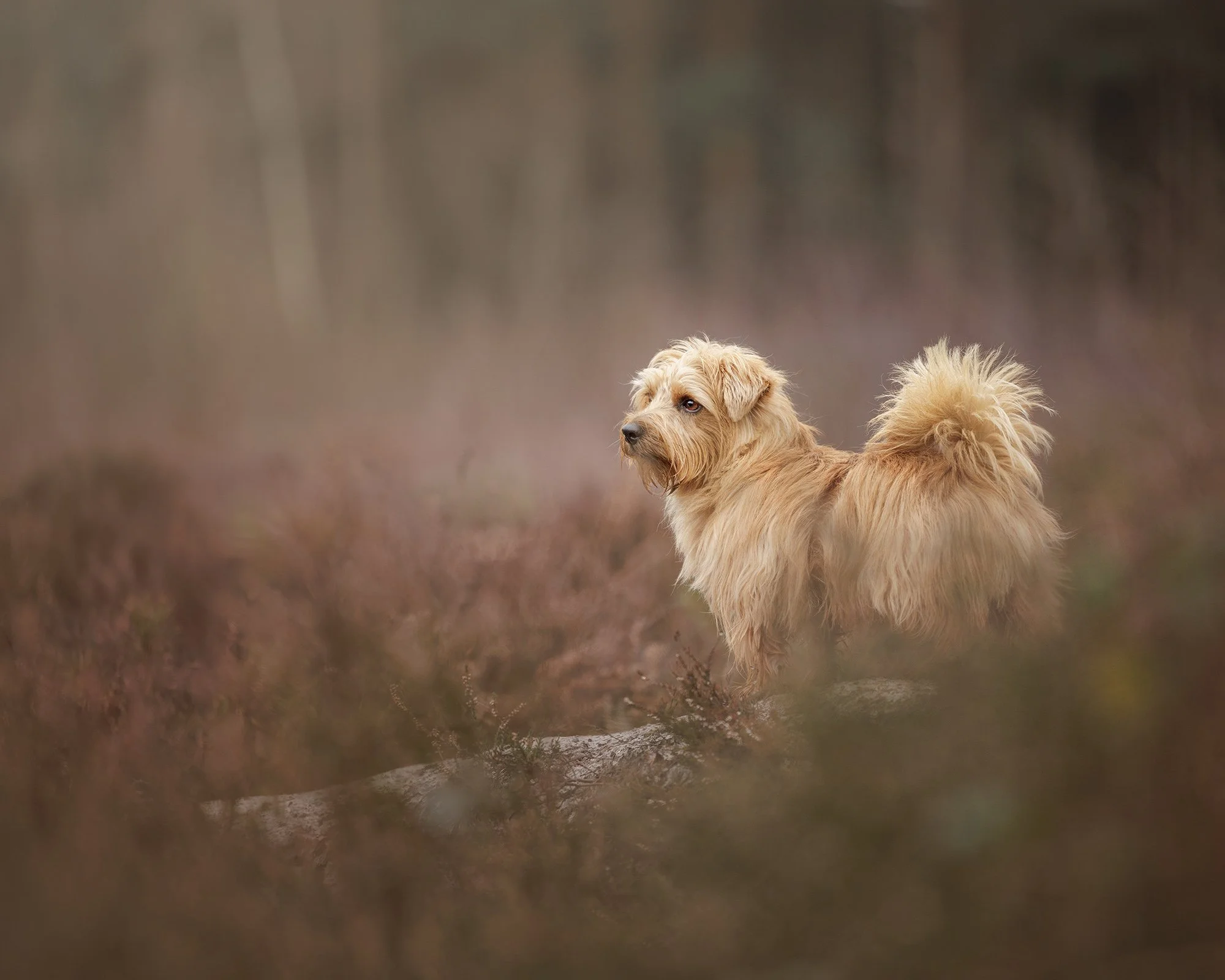
Oscar was my Jachshund. I had him as a teenager, and he was extremely fear-reactive. At home, with me, he was the most loving boy - but the outside world was a different story. Almost everything and everyone in it frightened him, and I had no framework for understanding that at the time. Like most people, I had grown up in a world where reactivity and aggression were treated as the same thing, so for a long time, I did not understand what Oscar was actually telling me.
What he was telling me, of course, was that he was afraid.
When I moved out and took him with me, I threw myself into learning everything I could about his triggers, his thresholds, and what it actually meant to keep a reactive dog genuinely comfortable in the world. We made small steps. He was always, at heart, a homebody who loved cuddling up in front of the TV. But he had a good life, and he was deeply loved, and when Theo - my miniature pinscher - came along, he adored her. With her beside him, he found he could enjoy short walks in parks. That mattered enormously.
Oscar passed away some years ago now, and there is a strong grief in that which I carry every day. Because of my aphantasia, I know that without photographic evidence, my memory works differently from most people's. I did not photograph Oscar in his final months because I wanted to remember him as he was before he became ill - and I still believe that was the right decision for me. But what it left me with were grainy phone photographs from technology of a different era, and the knowledge of what it feels like to wish you had more.
I think about that - and him - every single time I photograph a reactive or nervous dog. Every single time.
All dogs deserve to be celebrated, remembered, and immortalised in photographs. And reactive dogs - many of whom have been through more in their lives than most people will ever know - deserve to be captured as their true selves. Not as their behaviour. Not as their diagnosis. As themselves.

Oscar is the reason this philosophy exists. Every nervous dog I work with, I work with because of him.
What reactive behaviour actually is
I was attacked by a dog when I was eleven years old. I say this not for shock, but because I think it is worth being honest about: I know what it feels like to be on the receiving end of fear turned outward, and I also know that dogs are rarely born that way. The dog who attacked me was one who had been horribly failed by the humans around him, forced into fighting and shaped by experiences no dog should ever endure. I never blamed him for what happened. Even as a child, I understood that it wasn’t his fault.
And I am still here, still working with dogs every single day, and not remotely frightened of them.
Because what I understand now, having lived with Oscar and studied reactivity formally since, is that a barking dog is a talking dog. Reactivity is communication. Lunging, barking, shutting down, hypervigilance, freezing, pulling away - these are not personality flaws or signs of a bad dog or evidence of a failed owner. They are information. A dog telling you, and anyone paying attention, exactly what they need.
As a society, we have become very accustomed to treating a barking dog as a problem to be managed or a source of embarrassment. I understand why - it is stressful, it draws attention, and it can feel like a reflection of something you have done wrong. It is not. And there is no version of any of this where I will judge you or your dog for it. I like talking to dogs more than most people, honestly. A dog who has something to say is a dog I find interesting.
Barking is not aggression. It is a sentence. Learning to read it changes everything.
What I actually do when we meet
One of the things I tell clients during our consultation call is this: when we meet for the first time, I will completely ignore your dog.
The reason I say this is that I once had a client who, when we met, asked if I was scared of dogs because I didn’t immediately coo and talk in a baby voice while pawing at her dog. I explained that no, I was not scared - quite the opposite. I ignore dogs I am meeting for the first time because I love them, and because I understand that the world is full of strangers who immediately drop to their knees and try to intrude in a dog’s space who have not asked for that to happen. Dogs, largely, hate this. And then people wonder why the dog barks at them.
I let dogs dictate the conversations we have. If a session ends with a dog rubbing their face on my leg while I am sitting in the mud and they are licking my ear - which has happened, more than once - I welcome it completely. But I will never initiate that. I wait to be invited. Every time.
Throughout a session, I constantly watch the dog. Not just through the camera - before I pick the camera up, and between frames, and in every quiet moment in between. I am watching what happens when someone approaches head-on. What happens when a larger dog appears in the distance? How they respond to a specific sound, or a particular piece of equipment, or a change in the environment. I am a dog advocate first and a photographer second, and I am, if I can say so, quite good at noticing things and redirecting situations before they become problems - in ways that are so low-key that nobody in the group is usually aware it is happening.
If I need to step in and gently redirect the human at the end of the lead to communicate what their dog needs, I will. Always kindly. Always with the dog's well-being as the only consideration.
When something is not working, I stop.
This is the part I feel most strongly about, so I want to be very direct.
No photograph is worth frightening a dog for. Not one. And I will never push a dog into something they do not want to do for the sake of an image that clearly shows them looking stressed. That is not the kind of work I do, and it is not the kind of memory I want to help anyone keep.
I have called off sessions when I knew it was the right thing to do. At a studio taster event, a dog arrived who was clearly overwhelmed by the environment - not just the photography, but the whole situation. I began my desensitisation process carefully, watching. Within a minute or so, I knew it was not going to work. Not there, not in that environment, not that day. So I told his guardian that I would love to see them for a private session instead, and that today was not the right time.
I said, “he doesn't want this.”
She said, "Well, I do."
And that was the end of it.
I asked them to leave, and I would do so again without hesitation. The session exists for the dog. Full stop.
The bin bag story
Not every session with a nervous dog is heavy, and I want to be clear about that, too. Some of them are genuinely funny in retrospect, once everyone is comfortable and the photographs are done.
At a studio taster session in a private room at a groomer's, a bulldog arrived - confident, friendly, completely unfazed by the equipment, the camera and me. The desensitisation process went smoothly. And then, quite suddenly, she froze on the paper backdrop and walked out of the room.
I said to let her go. It was a locked building, so it was safe to do so. She came straight back in on her own terms, took a treat, and walked back out again. She kept reintroducing herself to the space - coming in, investigating, leaving. She was not anxious about the paper, or the lights, or me, or the camera. Something else was making the room feel wrong, and she was handling it in the most self-possessed way imaginable.
I asked her human if they could think of anything. They could not. Because the sessions were early in the day and they lived nearby, I suggested taking her home to decompress and coming back later, when I was technically finished, for another try. Her guardian agreed.
When she returned that afternoon, the same thing began happening again - but this time, she stood still just long enough, and she gave me a clear line of sight to follow over my shoulder.
"Bit of a weird one," I said, "but is she scared of bin bags?"
"Yes!" her guardian said. "She's terrified of black bin bags."
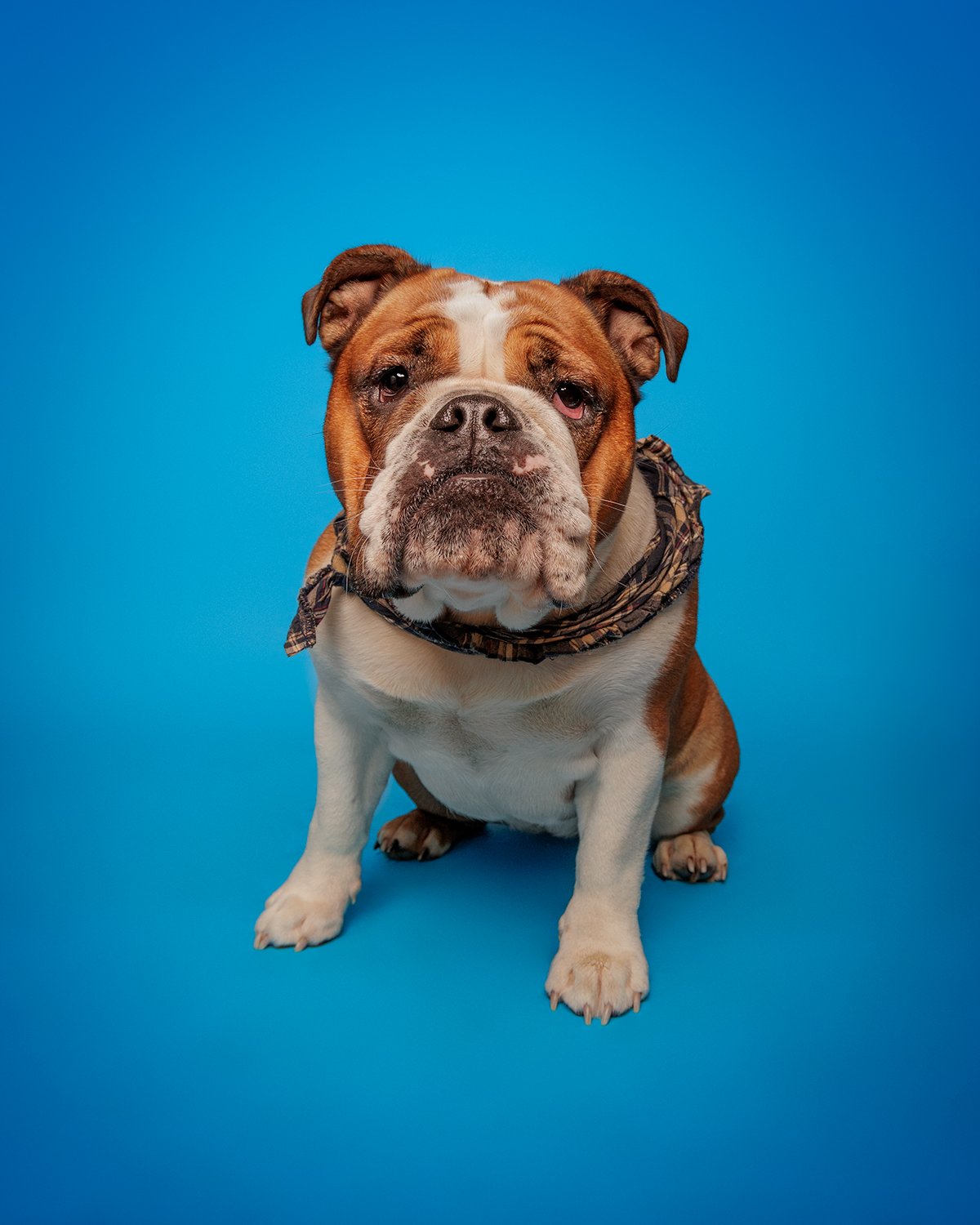
On a high shelf at the back of the room, barely visible: a small tuft of black plastic sticking out from behind something else. We removed it. And that bulldog proceeded to behave as though she had been photographed her entire life.
The point is not the bin bag. The point is that I was watching closely enough to notice where she was looking. And that her human trusted me enough to come back and try again. That trust goes both ways, always.
If you're looking for a dog photographer in London who will advocate for your dog as much as photograph them, you can learn more about my sessions here.
Environments matter - and they can be adapted
One of the things I always ask about on consultation calls is reactivity. Not because it changes whether I will work with a dog - it does not - but because it changes how I plan the session so that we are giving that dog the best possible chance of feeling genuinely comfortable.
For outdoor sessions, I will suggest locations that minimise known triggers as much as possible. Sunrise sessions are something I love for the quality of light, and for nervous or reactive dogs, they are a genuine non-negotiable: fewer people, fewer dogs, fewer opportunities for situations to arise that push a dog past their threshold. I will never ask a dog to perform submissive or still behaviour when they are already managing something difficult. That is not fair, and it does not produce the kind of photographs I want to make anyway.
For studio sessions, I offer the option of working in my home or a client's home rather than a formal studio. Locations can sometimes carry associations - the groomer, the vet - that add a layer of wariness before we have even begun. A dog in their own home is already on familiar ground, and that changes everything about how quickly they settle and how naturally they show themselves. If a client's home is not practical, we can discuss alternatives that suit the individual dog.
You can read more about how I approach studio taster sessions and the desensitisation process I use in my preparation guide here. And if your dog is more chaotic than anxious - bouncy, energetic, "untrained" in the traditional sense - you might find my blog on photographing dogs without formal training useful too, as the emotional territory is a little different.
What these photographs actually look like
I want to address something directly, because I think it is one of the things people with reactive or nervous dogs worry about most: will the photographs actually be beautiful, or will they just show a dog who looks scared?
In my experience - and I have a lot of it with exactly these dogs - the answer is that the photographs are often the most emotionally honest and powerful I make. Not because stress makes good portraits. It does not, and I would never let it get that far. But because dogs who have had to work hard to trust the world, when they relax into a session, show a version of themselves that is so vivid and so real that the camera cannot help but catch it.
That moment - when a dog who arrived guarded and uncertain drops their shoulders, starts investigating something in the grass, stops performing caution and simply becomes present - that is the moment I am always waiting for. It does not require obedience. It does not require tricks, or stillness, or any of the things people assume photographs need. It just requires the dog to feel safe enough to be themselves.
And when that happens, with a dog who has made me earn that feeling? I am always so grateful. Because I know exactly how much it means. I lived with Oscar for years. I know what it looks like when a fearful dog decides, finally, that something is alright.
It looks like everything.

"Photoshoot day was fun - the dogs were totally not prepared for the experience and got overly anxious and reactive. Amie was just superb - she was super calm and took control of the entire situation and got the dogs and us working the way she wanted. The photos are just beyond stunning - they capture our dogs beautifully and really are quite something."
- From Nan’s Google Review
You do not need to apologise
I want to end here because I think this is what matters most.
If you have a reactive dog, you have probably spent a significant amount of your life managing the way other people respond to them - apologising, explaining, bracing for judgment. I understand that. I lived it with Oscar, and I see it in almost every client who arrives at a session with a dog who has a complex relationship with the world.
There is no apology needed here. Not from you, and not from your dog. Reactivity is not a character flaw. It is not a failure of training or of love. It is, very often, the result of a dog who has experienced something difficult and is doing their absolute best with the tools they have. I have enormous respect for that. And I have enormous respect for the people who love those dogs through it, every single day.
What your dog deserves - what every dog deserves - is to be seen properly. Celebrated. Remembered. Captured not as their behaviour, but as themselves: the version of them that only the people they truly trust ever get to see.
I would like to be one of those people, if they will let me.
-
Absolutely. Reactive, nervous and shy dogs are always welcome. I plan each session around your dog’s individual triggers, comfort, body language and threshold. We can choose quieter London or Surrey locations and times, or use my private Wimbledon studio / mobile studio setup if that would suit your dog better.
-
Absolutely not. Your dog never needs to be off lead for a photography session with me. Reliable recall is not required, and many of the dogs you see in my portfolio were safely on lead when the photograph was taken. I position leads carefully during the session and can often remove them afterwards during retouching.
-
That’s completely okay. I never force interaction or contact. I give dogs space, let them approach at their own pace, and adapt how I work depending on what helps them feel comfortable. I have a lot of experience working with nervous dogs.
-
It depends entirely on your dog and their triggers. Some dogs are happiest in a quiet outdoor space, while others find a private studio or their own home easier. We can talk through what your dog finds difficult before the session and choose the option that gives them the best chance of feeling relaxed.
-
We stop, pause or change what we’re doing. The photograph never matters more than your dog’s welfare. Breaks, sniffing and decompression are always welcome, and I adapt the session rather than pushing a dog through something they’re uncomfortable with.

If this blog has felt like a relief
That is exactly what it was meant to be. If you have a reactive, nervous, or shy dog and you have always wondered whether a session could work for them, I would love to talk it through with you. No question is too detailed, and no history is too complicated. You can find out more about how I work and get in touch through my portrait page, or simply send me a message directly. Your dog does not need to be ready for the world. They just need to feel safe with me.